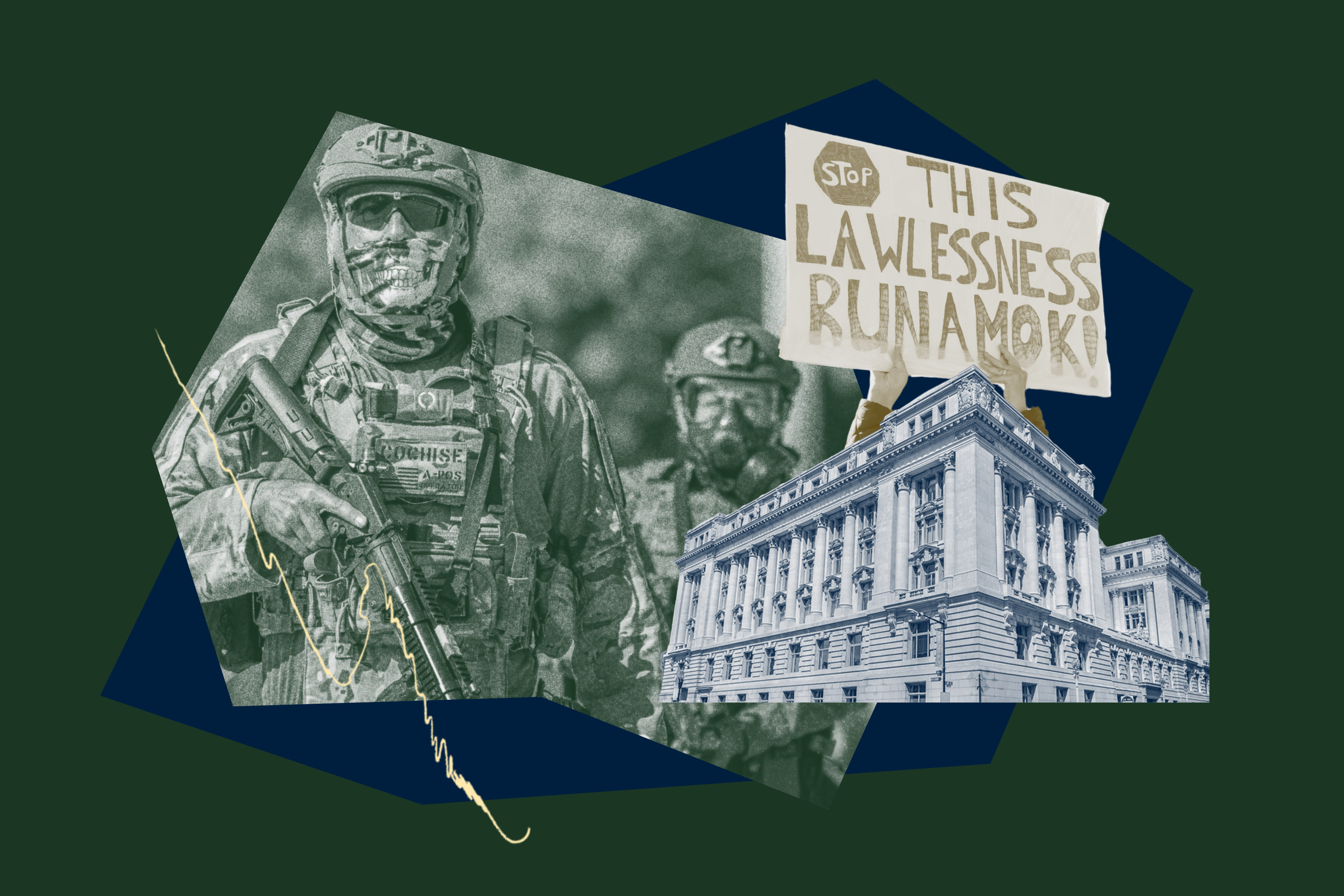
Federal agents across the country have arrested U.S. citizens, dragged children from their beds, smashed car windows, and shot, sometimes fatally, people they encounter.
As these agents advance President Trump’s extreme agenda, many have watched in horror as federal agents trample people’s constitutional rights, acting as though they are immune from accountability. All too often, they are. Because of court doctrines and congressional inaction, suing federal agents under federal law is often extremely difficult.
But D.C. leaders can fill that gap. By passing a new law, the D.C. Council can ensure that federal officers, no less than local agents, answer for the harms they cause in the District of Columbia.
Left unchecked, federal agents’ impunity invites further wrongdoing, turns our constitutional protections into empty promises, and makes us all less safe. As federal officers become more aggressive and commit more constitutional violations, sometimes with deadly results, it is even more critical for D.C. leaders to act.
District of Columbia residents and visitors are policed not only by District law enforcement but also by federal law enforcement – including several federal agencies whose officers are frequently active around D.C., such as the Park Police, Secret Service, Capitol Police, and more. Federal officers working in D.C. is not unique to our present times, but it has certainly increased during the current Presidential Administration. Further, shootings by federal law enforcement in Minnesota, Maine, Texas, and elsewhere have heightened concerns about accountability of federal officers for constitutional violations.
If federal agents are acting like they are above accountability, it's because, all too often, they are. Because of court doctrines and congressional inaction, suing federal agents under federal law is often extremely difficult. As a result, the accountability mechanisms for D.C. and federal officers now differ dramatically. People can sue local law enforcement under 42 U.S.C. § 1983, which provides the full range of remedies, whereas the latter may be sued only under the Federal Tort Claims Act, which is littered with exceptions and limitations.
A stark example of the differences in enforcement mechanisms available is the ACLU-D.C. ongoing case Black Lives Matter D.C. (BLM-DC) v. United States, in which the courts held that our constitutional claims could proceed against D.C. police officers but we lacked a constitutional cause of action against the federal officers, and instead had to pursue the more limited relief available under the FTCA.
This legislation would allow for any law enforcement officer -- including Federal law enforcement officers who, under the current legal schema are not subjected to any meaningful accountability mechanism -- that violates constitutional rights while acting under the color of any law or with legal authority granted by D.C., to be sued in D.C. Superior Court under D.C. laws.
You have already shown true leadership and commitment to protecting the D.C. community by passing two temporary laws that shine a very bright light on what federal officers are doing to the people of D.C.
Now, we urge you to pass legislation allowing people to sue federal agents when officers violate people's constitutional rights in Washington, D.C. We urge you to join leaders in states where similar legislation is moving forward, including Maryland, Connecticut, New York, Massachusetts, Rhode Island, and Vermont.
We cannot wait for Congress to do what is right. We are counting on you to ensure that no federal agent is above the law in the District of Columbia. People in D.C. need to be able to hold any law enforcement agent accountable when their constitutional rights are violated, no matter who issued the badge the officer wears.